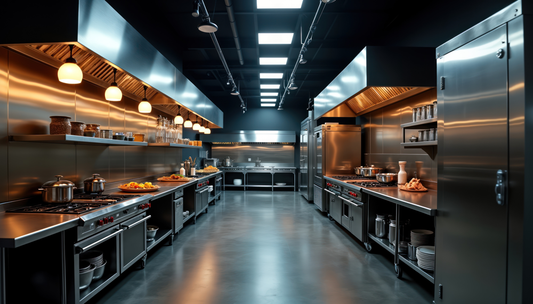
The first kitchen I stood in on a Saturday night had a floor faintly tacky underfoot, an extractor that sounded like a light aircraft, and a chef who could tell the time by how hot the fryer oil smelled. I was twenty-two. The kit looked like chaos to me - griddle here, fridge wedged in there, a bain-marie balanced on something never designed to hold one.
It wasn't chaos. It was specific. Every piece of commercial catering equipment in that room had been chosen for that menu and that number of covers on a Saturday. Nobody had handed them a list.
Thirty-plus years on, running eCatering, the question that still lands in my inbox most often is some version of: what commercial catering equipment do I actually need? And nearly every answer online is the same generic checklist. Fridge. Oven. Fryer. Dishwasher. Prep table. Next.
That list isn't wrong. It's just useless, because a wet-led pub in Leeds and a 60-bed care home in County Durham share almost nothing beyond a cold store and a sink. The equipment doesn't decide the venue. The venue decides the equipment.
So this guide runs the other way round. Seven venue types, the kit that matters in each, real UK pricing excluding VAT, the one decision that defines your spec, and the compliance regime you'll be judged against. No fluff. Real kit. Real prices.
- Andrew Pickersgill, Managing Director, eCatering
Start with the venue, not the equipment list
Here's the mistake I watch people make over and over.
They find a checklist, print it, and price it line by line. Twelve items, twelve ticks. It feels like progress. Then they open, and inside a fortnight the fryer can't recover between orders, the fridge runs half empty, and a £4,000 combi is doing a job a £500 convection oven would have done better.
The checklist wasn't the problem. The sequencing was. A category-first list tells you what kinds of commercial catering equipment exist. It can't tell you which of them your business will lean on, because it doesn't know what you're selling or to how many people.
We publish the category-first version too, and it's genuinely thorough - for depth on refrigeration types, oven formats, warewashing tiers and layout, read our full commercial kitchen equipment list. Treat the two as a pair. That one is the reference manual. This one is the decision framework.
The framework is where the money gets saved. A venue-first approach forces four questions in the right order - what you're selling, to how many, in what building, on what supply - and the equipment list falls out of the answers instead of being imposed on top of them.
Get the venue right and the spec more or less writes itself. Get it wrong and you'll spend year one buying your way out of week one.
The universal baseline: six things every commercial kitchen needs
There is a genuine baseline. Six categories, present in some form in every commercial kitchen in the UK.
- Refrigeration. The FSA requires chilled food held at 0–5°C, which means undercounters, uprights, prep counters, bottle coolers and freezers built to hold temperature with the door opening forty times an hour. See commercial fridges and upright and chest freezers.
- Cooking. Ovens, ranges, fryers, griddles, grills — sized to your peak, never your average. Formats compared across our range of commercial ovens.
- Warewashing. A commercial machine runs a 2–3 minute cycle with a high-temperature final rinse. A domestic one takes 90 minutes-plus and doesn't sanitise to commercial standard. Glasswashers take a 400mm basket, dishwashers 500mm, pass-through hoods handle volume. Compare glasswashers and dishwashers.
- Preparation. Stainless tables, sinks, boards, mixers, slicers. A separate hand-wash basin is not a nice-to-have. Not optional.
- Storage. Ambient shelving and racking, with chemical storage held physically apart from food.
- Extraction. Canopy, filters, ductwork, make-up air. DW172 is the BESA Specification for Kitchen Ventilation Systems, and it's the benchmark EHOs, insurers and consultants assess you against. Add gas and you also need a BS 6173 gas interlock - gas won't flow unless extraction is proven running.
Then the seventh, the one operators forget until an inspection reminds them: a proper cleaning and hygiene programme. Not a cupboard with some spray in it. A documented regime with the right chemistry for the right surfaces - and kit specified so it can actually be stripped and cleaned at close, rather than fought with.
Commercial catering equipment by venue type
Seven venues, seven different answers. Every cost band below is equipment only, excluding VAT, and excludes installation, extraction ducting, services and fit-out.
Bars and pubs
Wet-led or food-led. That's the whole conversation.
Must-haves: bottle coolers and back bar refrigeration, glasswasher, ice machine, cellar cooling and keg storage, bar blenders, and - only if you're doing food - a compact cooking line under a canopy. We take that list apart piece by piece in our item-by-item checklist for opening a pub.
Cost bands (equipment only, ex VAT): entry, wet-led with minimal food, £4,000–£8,000. Mid, a food-led pub kitchen, £10,000–£20,000. Premium gastropub with a beer garden servery, £25,000–£45,000. Those are equipment figures only; the licence, the lease and the fit-out around them sit in what opening a pub costs once everything else is added in.
The biggest decision: do you commit to food, and therefore to extraction? A wet-led bar needs no canopy. The moment a fryer or chargrill goes in you've triggered DW172 ducting and, on gas, a BS 6173 interlock - often dearer than the cooking kit itself. Then size ice and glasswashing to peak: a match-day Saturday in Leeds runs three to four times a wet Tuesday, and the cellar and the glass line break first.
Compliance: Licensing Act 2003 conditions, FHRS scoring on glasswashing hygiene, cellar temperature control, DW172 and BS 6173 on a gas kitchen, and TR19 grease duct cleaning records your insurer will want to see.
Kit that earns its place: the Contender 220L Double Door Bottle Cooler at around £380 ex VAT (fan-assisted, +2°C to +9°C, four adjustable shelves) and the Contender PRO Glasswasher, 400mm basket, at £967.95 ex VAT. Bundle routes: The Back Bar Bundle at £1,099.99 as listed, The Pub Kitchen Bundle at £1,599.99, The Beer Garden Kitchen at £1,149.99 — all on our page of equipment built for high-volume bar service.
Bistros and cafés
Small footprint, long trading day, one piece of kit that governs everything.
Must-haves: espresso machine and grinder, chilled and ambient display refrigeration, undercounter fridge and freezer, panini or contact grill, conveyor toaster, prep counter, and a glasswasher or small dishwasher. There is more detail on the same list, including the counter layout that decides your queue, in what a café kitchen needs before day one.
Cost bands (equipment only, ex VAT): entry £8,000–£12,000, mid £15,000–£25,000, premium all-day brunch with in-house bakery £30,000–£50,000. Equipment is only part of it — the shopfit, the rent deposit and the opening stock all sit in what a café costs to open from an empty unit.
The biggest decision: two-group or three-group espresso machine. It's usually your largest single line item and the hard throughput ceiling on the whole business. A two-group tops out around 150–200 drinks in a morning peak. Past that it isn't the kitchen that kills you, it's the queue — and no other purchase fixes it.
Compliance: Natasha's Law is the big one here. Anything pre-packed for direct sale - grab-and-go sandwiches, salads, traybakes - needs a full ingredient list with the 14 allergens emphasised. That's a labelling process, not a purchase. Add FHRS scoring, which is visible and moves footfall, plus hand-wash basin provision.
Kit that earns its place: the Quattro Conveyor Toaster at £240.81 ex VAT for 150 slices/hr, or £331.65 ex VAT at 450 slices/hr, and the Contender 130L Undercounter Fridge (RRS007) at £324.99 ex VAT with its matching FZN010 freezer at £374.55 ex VAT. The Pizza and Drinks Bundle sits at £1,399.99 as listed - where a good few Bristol independents start before bolting on. Everything else is on our page of compact kit for all-day café trading.
Takeaways
Output per square metre. That's the entire brief.
Must-haves: fryers with multiple pots, hot holding and heated display, a pizza oven or kebab grill depending on concept, chest and undercounter refrigeration, prep counter, extraction canopy, and the packaging and consumables nobody budgets for. That consumables line is the one that catches people out, and we price it properly in the kit list for a takeaway fit-out rather than leaving it as an afterthought.
Cost bands (equipment only, ex VAT): entry £6,000–£10,000 on a Quattro-led build, mid £12,000–£20,000 Contender-led, premium £25,000–£40,000 and up. Extraction, shopfront and delivery-platform setup sit on top of these bands, and we cost all of it in what a takeaway build actually costs line by line.
The biggest decision: fryer capacity, and how many separate oil pots. One pot is two problems at once — an allergen problem, with fish, chicken, vegan and gluten-free sharing oil, and a recovery problem, because the cold drop when a full basket goes in on a Friday night is the classic bottleneck. Two smaller pots almost always beat one big one, and cost less.
Compliance: FHRS is commercially load-bearing here in a way it isn't elsewhere - the delivery platforms require a minimum hygiene rating, so a poor score removes revenue immediately. Then allergen separation, waste oil disposal records, and DW172 plus a BS 6173 interlock on gas fryers.
Kit that earns its place: the Quattro FCE004 13L single fryer at £114.81 ex VAT makes a dedicated allergen pot — the cheapest compliance win in this article — while the Contender FCE091 16L Pressure Chicken Fryer at £591.66 ex VAT runs roughly eight portions per four-minute cycle at 165°C, about 120 portions an hour. Compare formats in our commercial fryer range. For pizza-led concepts the Contender Twin Deck Pizza Oven (OVP012), single-phase, 12 × 13", at £1,261.15 ex VAT turns 50–60 pizzas an hour — boring, reliable repetition, which is exactly what you want on a Saturday night. More in our pizza oven collection. The Takeaway Kitchen bundle at £2,199.99 as listed pairs that twin deck with a Contender kebab knife slicer, a Contender 45cm dough roller and a KINN 4 Burner Electric Kebab Grill. Cardiff operators tend to start from our page of high-output takeaway equipment.
Hotels
Two completely different services, one kitchen, and no permission to ever close.
Must-haves: combi ovens, a full cooking suite, walk-in or high-capacity refrigeration, a pass-through or rack dishwasher, high-output ice, a breakfast line (toaster, juice, coffee, crepe or waffle), banqueting hot holding and trolleys, and bar refrigeration. That is two equipment lists sharing one kitchen, and we separate them out in our checklist for kitting out a hotel kitchen.
Cost bands (equipment only, ex VAT): entry, a boutique or B&B doing 20–40 breakfast covers, £25,000–£40,000. Mid, 80–150 rooms with restaurant and bar, £50,000–£90,000. Premium, banqueting and conferencing across multiple outlets, £120,000–£250,000 and beyond.
The biggest decision: how one kitchen handles two entirely different peaks. Breakfast is a 90-minute compressed rush at near-total concurrency — everyone wants eggs at once. Dinner spreads over three hours. Room service sits on top, round the clock. The answer is almost always combi ovens plus regeneration capacity rather than a longer conventional line, and redundancy, because a hotel kitchen cannot shut. Ask any head chef in Edinburgh or Glasgow who has lost an oven in August. Two mid-size units beat one large one.
Compliance: HACCP records that survive shift handovers, Food Information Regulations across room service and banqueting menus, TR19 extraction cleaning at higher frequency, fire compartmentation between kitchen and guest accommodation, and water hygiene management where ice and beverage machines run continuously.
Kit that earns its place: the Contender Pass-Through Hood Dishwasher (DMH017) at £1,691.47 ex VAT, three-phase, turning racks fast enough to keep the pass clear, plus a Quattro Titanium 108L Convection Oven (OVC005) at £562.49 ex VAT as backup — cheap insurance for the day the main line goes down. At the top end a Rational iCombi Pro 6-1/1 sits around £6,500–£8,500 ex VAT. The Continental Breakfast Bundle (£1,999.99 as listed) and The Evening Service Bundle (£1,149.99) map onto the two services, and both feature on our page of full hotel kitchen solutions.
Healthcare and care homes
The highest evidential burden in UK catering, and the one venue where equipment choices are clinical as well as operational.
Must-haves: regeneration ovens or combis, texture-modification kit (high-power blenders, moulds, processors), bain-maries and heated trolleys, monitored high-capacity refrigeration, a commercial dishwasher, a dedicated allergen prep zone, and hygienic stainless furniture with hand-wash provision. Texture-modification kit is where most of the spec risk sits, and there is more on it in our guide to specifying a care home kitchen.
Cost bands (equipment only, ex VAT): entry, a 40–60 bed home running cook-serve, £15,000–£25,000. Mid, cook-chill regeneration or a multi-site kitchen, £30,000–£50,000. Premium, hospital or central production unit, £60,000–£90,000 and up.
The biggest decision: cook-serve or cook-chill regeneration. It changes everything downstream — blast chilling, refrigeration volume, regeneration trolleys, the whole staffing model. Close behind: how you produce IDDSI-compliant texture-modified meals consistently. That's a genuine equipment question - moulds, high-power blenders, accurate portioning - not simply a recipe question, whatever anyone tells you.
Compliance: CQC Regulation 14 on nutritional and hydration needs, the IDDSI framework levels 0–7 for dysphagia texture modification and thickened drinks, allergen information tied to each individual resident's record with documented anti-cross-contamination systems, and HACCP with temperature logs. Catering for vulnerable people carries a materially higher burden of proof than catering for restaurant guests.
Kit that earns its place: the Contender 1800W Heavy Duty Commercial Microwave (MIC055) at £639.45 ex VAT for regeneration duty, and the Quattro 1/1 Wet Bain Marie with tap (EBW001) at £130.16 ex VAT, one of our steadiest sellers across Yorkshire and North East care home groups. For scale production the Contender H20 Twin Speed 48L Mixer (MXD051) runs £1,308.48 ex VAT, three-phase. The Canteen Prep Bundle at £999.99 as listed is a sensible starting block, with a documented cleaning regime built around it, because in a care setting hygiene is part of the specification rather than a chore bolted on afterwards. Detail on our page of hygienic equipment for care environments.
Restaurants
The broadest spec of the seven, and the one where a single decision echoes for a decade.
Must-haves: a cooking suite (range, oven, grill, fryer), a combi or convection oven, refrigeration across upright, undercounter and prep counter, freezer capacity, a dishwasher, prep tables and sinks, an extraction canopy, and front-of-house bar refrigeration and ice. It is the longest list of the seven, and we work through it section by section in our breakdown of everything a restaurant kitchen needs.
Cost bands (equipment only, ex VAT): entry, 40–60 covers on a tight menu, £15,000–£25,000. Mid, 80–120 covers, £30,000–£55,000. Premium, fine dining with a multi-section brigade, £70,000–£120,000 and above. Add building work, extraction and front of house and the number moves considerably; we set those against the equipment spend in the full cost of opening a restaurant in the UK.
The biggest decision: the cooking suite - gas or induction, modular or monobloc. This one dictates your power supply, your extraction spec and your layout for the next ten years. Induction cuts extraction load and makes the kitchen a far better place to work a double in, but pushes you hard towards three-phase. Gas is cheaper to run and triggers the BS 6173 interlock plus heavier ducting. Decide it before the lease is signed. Not after.
Compliance: Food Safety Act 1990 and HACCP, Natasha's Law wherever anything is pre-packed for direct sale, an allergen matrix and trained staff under the Food Information Regulations, DW172 and BS 6173, FHRS display (mandatory in Wales and Northern Ireland, voluntary in England), and a fire risk assessment covering the extract system.
Kit that earns its place: the Contender 400L Upright Freezer (FZU066) at £593.31 ex VAT alongside a Quattro 1200mm Extraction Hood with LED at £349.16 ex VAT and a Quattro 1500mm Twin Bowl Sink at £266.65 ex VAT. Where volume justifies a step up on warewashing, a Classeq D500DUO pass-through is £2,999.00 ex VAT. Most Manchester independents we fit out start from The Starter Kitchen at £2,199.99 as listed, with The Asian Kitchen (£899.99), The Pizza Kitchen (£1,599.99) and The Butchery Bundle (£699.99) covering concept-led builds. Our mid-range Contender line is where most restaurant specs land, and there's a full breakdown on our page of professional restaurant equipment for front and back of house.
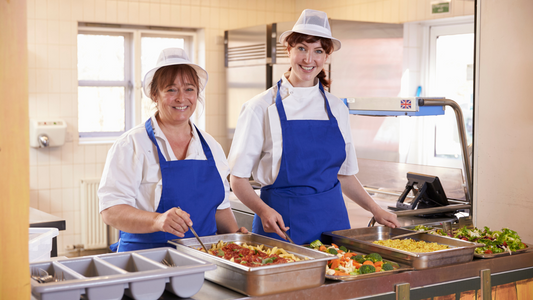
Education and school canteens
A school kitchen doesn't have a peak. It has a wall.
Must-haves: a bank of convection or combi ovens (or bratt pans), high-capacity refrigeration and freezing, hot holding, servery counters and refrigerated topping units, a pass-through hood dishwasher, clearing trolleys and racking, a griddle or fryer for menu variety, and an allergen-segregated prep area. The servery and tray-return side is usually where the service window is won or lost, and covers it in more depth.
Cost bands (equipment only, ex VAT): entry, a primary doing around 250 meals a day, £15,000–£25,000. Mid, a secondary at 500–800 meals a day, £30,000–£55,000. Premium, a multi-serving-point academy or trust central kitchen, £70,000–£120,000 and up.
The biggest decision: batch capacity against a fixed service window. Six hundred meals leave the pass in 45 to 60 minutes, every day, at a price per head nobody is renegotiating. That maths pushes you towards bratt pans and combis with regeneration racks rather than stacking oven decks, and towards a pass-through dishwasher that turns trays as fast as they come back through the hatch. Throughput, not versatility.
Compliance: The Requirements for School Food Regulations 2014 - the School Food Standards — are mandatory for maintained schools, academies and free schools in England, and they dictate menu composition and therefore equipment mix: more veg prep, less deep-fat frying, with fried food restricted to no more than twice a week. Building Bulletin 103 gives non-mandatory kitchen area guidance. Then allergen policy for pupils with recorded allergies, and FSA 0–5°C cold storage with monitored thermometers.
Kit that earns its place: the Contender Pass-Through Hood Dishwasher (DMH017) at £1,691.47 ex VAT, three-phase, doing the heavy lifting on tray turnaround. The Contender 42L Convection Oven with rotisserie and the Contender Eco 550mm Electric Griddle both sit inside The School Kitchen Bundle at £1,799.99 as listed, alongside a Quattro 3-Tier Clearing Trolley; The School Dinner Bundle at £1,379.99 adds a Contender 1800mm Refrigerated Topping Unit for servery work. Our entry-level Quattro line covers the trolleys, tables and sinks that surround the hero kit, and the Birmingham and West Midlands academy trusts we supply usually start from our page of durable, high-capacity canteen kitchen kit.
The four questions that decide your spec
Get those four right, and everything else slots in around them.
One: how many covers at peak? Not average. Peak. Every sizing decision flows from this single number - fryer pots, oven decks, fridge litres, dishwasher racks per hour. As a worked example, 300 covers across an evening is comfortably one 24L fryer. Push past that and you twin them, because duty cycle and recovery time, not raw capacity, are what fail you.
Two: what power supply have you actually got? This is the one that catches people, so here it is in plain terms.
- 13A single-phase plug, around 3kW. Microwaves, panini grills, countertop fryers, small countertop pizza ovens, blenders, toasters.
- 16A or 32A single-phase, hard-wired, around 3.7–7.4kW. Convection ovens, larger fryers, undercounter dishwashers, twin-deck pizza ovens (13A variants do exist).
- Three-phase 400V, 22kW-plus per run. Combi ovens, pass-through and rack dishwashers, bratt pans, large deck ovens, 48L spiral mixers.
- Gas, natural or LPG. Fryers, ranges, chargrills - and an automatic trigger for a BS 6173 interlock plus DW172 ducted extraction.
A fully equipped commercial kitchen can draw 50–100kW of total electrical capacity. A DNO three-phase upgrade runs roughly £1,500–£4,000 where the local network already has capacity, and £3,500 to £15,000 where excavation or reinforcement is needed. Lead times run from weeks to several months.
So: check the incoming supply before you sign the lease, not after you've bought the oven. I've had that conversation more times than I'd like.
Three: what space and extraction have you got? Canopy footprint, duct route to atmosphere, make-up air, and whether the landlord or the planners will permit a flue at all. Budget £2,500–£6,000 for a bespoke canopy on a small-to-mid site, before ducting.
Four: what's the budget, and how are you funding it? Which brings us to the next two sections.
Why bundles beat buying piecemeal
I'm aware how this sounds coming from someone who sells bundles, so here are the four arguments on their merits.
Cost. Bundle pricing sits below the sum of the parts. Ours run from £699.99 to £2,199.99 as listed, which covers a real starting position for all seven venue types above.
Compatibility. Matched units share footprints, voltages and shelf heights. Buy five items from five suppliers and you'll find out on installation day that the prep counter is 30mm taller than the run it's meant to join.
Delivery. One consignment, one slot, one point of contact. Piecemeal means five lead times, and your opening date is set by the slowest. That's not theoretical — it's the most common reason openings slip.
Warranty and support. One warranty conversation, one engineer route. When something fails mid-service you want one number to ring, not a folder.
Worth noticing how our complete kitchen bundles are built: overwhelmingly Contender-led, our mid-range, with Quattro — the entry-level line — filling in prep tables, trolleys and centre benches. That's deliberate. The mid-range does the heavy lifting on refrigeration, cooking and warewashing, where duty cycle decides whether you get through a busy year. The budget line does the supporting work, because a stainless table is a stainless table.
That's two of our three own-brands. The third is KINN, and it sits above both: our luxury range, sleek modern styling over proper commercial engineering, with a 2-year parts and labour warranty extendable to five. It's narrow by design — dough rollers and one-touch pizza formers at £897.78–£916.64 ex VAT, kebab grills in gas and electric at £641.64–£1,008.33 ex VAT, conveyor pizza ovens at £4,537.49–£8,333.31 ex VAT, and a commercial microwave. So the ladder reads Quattro for the supporting cast, Contender for the workhorses, KINN where pizza or kebabs are the business rather than a side line.
Budget planning: what the kit actually costs
Here's the number that ruins people's week, so let's get it out early.
Commercial catering equipment is roughly half your total fit-out spend. UK market data puts it at 40–50%, and our own experience sits squarely in that band. The rule of thumb I use is 50/25/25:
- 50% equipment - everything in this article.
- 25% installation and services - electrics, gas, plumbing, extraction, ducting, commissioning.
- 25% fit-out — floors, walls, ceilings, front of house, EPOS, furniture.
Total commercial kitchen setup in the UK typically lands between £30,000 and £150,000, with the full observed range running from around £11,000 for a small takeaway conversion to £400,000-plus for a hotel or production kitchen.
The honest framing, and the one I'd want if I were sitting where you are: if someone quotes you £40,000 of equipment, you need to find roughly £80,000. That isn't pessimism. That's the arithmetic of ducting, three-phase runs, commissioning and a floor that meets spec.
Every cost band in the venue section is equipment only, excluding VAT, and excludes installation, extraction, services and fit-out. Apply 50/25/25 to each and you'll have a realistic total. Do that now, on paper, while you can still change your mind about the room.
Buy or lease? The finance decision
Most operators should blend the two, and very few do.
Lease when you're preserving working capital for stock and staff, when the kit has a clear upgrade cycle, or when you're opening more than one site. Buy when you have capital available, the asset has a long life - stainless furniture, refrigeration, sinks, tables — and total cost of ownership matters more than monthly cashflow. The practical blend: buy the long-life, low-technology items outright and finance the high-value cooking and warewashing.
Across the finance options we offer, three routes are worth knowing. iwocaPay covers orders from £150 to £30,000, interest-free - Pay Now by bank transfer, or Pay Later across three equal interest-free monthly instalments - open to UK limited companies, LLPs and sole traders. Lease finance is selected at checkout and requires 18 months or more trading, homeowner status and good credit history; new tenant businesses need a guarantor, established tenants two-plus years trading. It accepts limited companies, partnerships, CICs, PLCs, sole traders and charities. PayPal Credit gives no interest for the first four months on orders over £99. RG Distributors is FCA-authorised, registration number 837158.
What I won't do is tell you how any of this sits with your tax position. That's a conversation for your accountant, who knows your circumstances. Ours don't extend that far.
Seven mistakes we see across every venue type
Not a top three. These are the ones that actually recur.
- Buying kit before checking the power supply. The DNO doesn't care that your oven has already arrived.
- Sizing for average covers instead of peak. Average is a comfort number. Peak is the one that breaks you.
- Leaving extraction and installation out of the budget. The canopy can genuinely cost more than the cooker under it.
- Putting domestic appliances into a commercial kitchen. The EHO will fail it, and your insurer may decline a claim.
- Buying piecemeal instead of bundling. More expensive, more deliveries, more mismatched worktop heights, more warranty conversations at the worst moment.
- Buying the cheapest option in the one category that carries your menu. Budget kit is the right answer for most of a first fit-out. It is the wrong answer for the appliance your signature dish runs through, because that unit works every service for a decade and a failed one closes you. If pizza or kebabs are the business, the KINN premium range exists for exactly that: a 2-year parts and labour warranty extendable to five, on the piece you cannot trade without.
- No allergen separation designed into the layout. Retrofitting a separate prep zone costs about three times what building it in does.
- Ignoring warranty terms and engineer response times. A cheap dishwasher with a ten-day engineer SLA is not a cheap dishwasher.
That's eight. The last one sneaks in because it's the one people are most surprised by.
When to bring in a Key Account Manager
There's a point where a website stops being the right tool, and I'd rather tell you where it is than pretend otherwise.
Bring in a Key Account Manager when you're fitting out a full kitchen from an empty room; when three-phase or gas installation is involved; when you're specifying across multiple sites; when you need bespoke stainless fabricated to a room's real dimensions; or when total spend goes past around £10,000. Below that, our bundles and category pages will get you most of the way. Above it, twenty minutes with someone who has stood in a hundred kitchens beats any amount of browsing.
The way our Key Account Managers put it is better than the way I do. The mistake isn't buying the wrong oven - it's buying any oven before anyone's looked at the room. Twenty minutes on site in Leeds or Bristol before you spend a penny beats a phone call three weeks after the kit's landed and it won't fit through the door.
You can see who you'd be dealing with on our meet the team page.
Frequently asked questions
What equipment do I need to open a restaurant in the UK?
Every UK restaurant needs six categories: refrigeration holding 0–5°C, cooking equipment sized to peak covers, a commercial dishwasher, stainless preparation surfaces and sinks, ambient storage, and extraction meeting DW172. Budget £15,000–£25,000 of equipment for a 40–60 cover site, excluding VAT.
Beyond that baseline the answer changes entirely with venue type and menu. A 60-cover bistro and a 60-cover pizzeria need different cooking lines, refrigeration volumes and extraction. Start from peak covers and menu, then work backwards to the spec.
How much does commercial catering equipment cost?
UK commercial catering equipment ranges from around £4,000 for a wet-led bar to £120,000-plus for a fine-dining brigade — equipment only, excluding VAT, installation and fit-out. Equipment typically represents 40–50% of total fit-out spend.
By venue, roughly: bars and pubs £4,000–£45,000, cafés £8,000–£50,000, takeaways £6,000–£40,000, care homes £15,000–£90,000, restaurants and schools £15,000–£120,000, hotels £25,000–£250,000. All ex VAT, equipment only. Total setup including services and fit-out usually lands between £30,000 and £150,000.
What's the difference between commercial and domestic catering equipment?
Commercial equipment is built for continuous duty cycles, carries commercial warranties, is accepted by Environmental Health and keeps your insurance valid. A commercial dishwasher completes a sanitising cycle in 2–3 minutes; a domestic machine takes 90 minutes or more and doesn't sanitise to commercial standard.
The difference shows in components - heavier compressors, thicker gauge stainless, serviceable parts - and in what happens when things go wrong. Domestic appliances in a commercial setting can undermine both your cover and your registration.
Do I need three-phase electricity for a commercial kitchen?
Not always. Plenty of small kitchens run entirely on single-phase using 13A and 32A appliances. You need three-phase for combi ovens, pass-through and rack dishwashers, bratt pans, large deck ovens and heavy mixers. A DNO connection costs roughly £1,500–£4,000 where network capacity exists.
Where excavation or reinforcement is required that can reach £15,000, and lead times run from weeks to several months. Check what supply the building actually has before committing to a lease or a spec.
Should I buy commercial equipment as a bundle or individually?
Bundles are usually the better route for a new opening. They cost less than the sum of the parts, the units are matched for footprint, voltage and worktop height, they arrive in one delivery, and they carry one warranty route. eCatering bundles start from £699.99 as listed.
Buy individually when you're replacing a single failed unit, or when your concept needs something genuinely specific that no bundle covers.
Can I lease commercial catering equipment in the UK?
Yes. eCatering offers iwocaPay on orders from £150 to £30,000, interest-free, paid now or across three equal monthly instalments. Lease finance is also available, requiring 18-plus months trading, homeowner status and good credit history. PayPal Credit gives four months interest-free on orders over £99.
Lease finance is selected at checkout, and the finance team confirms rates and schedules directly. New tenant businesses will typically need a guarantor.
Where to go next
You've got the framework. Now go to the page that matches your room.
- Bar or pub? Start with back bar refrigeration, ice and glasswashing.
- Café or bistro? Look at espresso, display refrigeration and counter cooking.
- Takeaway? Head for fryers, hot holding and high-output cooking.
- Hotel kitchen? See combi ovens, banqueting and breakfast service kit.
- Care home or healthcare setting? Review regeneration, texture modification and monitored refrigeration.
- Restaurant? Work through cooking suites, refrigeration and warewashing.
- School or academy canteen? Go to high-volume ovens, serveries and pass-through warewashing.
Then three practical steps. Price up a starting bundle for your venue type rather than a blank list. Check what interest-free credit and lease finance would do to your opening cashflow. And if the project is bigger than a bundle, talk to one of our Key Account Managers before you spend anything.
Thirty years in, I still think the same thing walking into a new kitchen that I thought at twenty-two: the room tells you what it needs, if you let it. Start there. Get the commercial catering equipment that matters right for your venue - refrigeration, cooking, warewashing and extraction - and everything else slots in around them.
Go and open the place.
- Andrew
Prices shown excluding VAT as of 9 August 2026 and are subject to change. Bundle prices are as listed on site. Cost bands cover equipment only and exclude installation, extraction, services and fit-out. Always check product specifications to ensure equipment meets your kitchen's requirements.
This article is for informational purposes. Business and finance decisions should account for your specific circumstances, local regulations, and professional advice where appropriate.