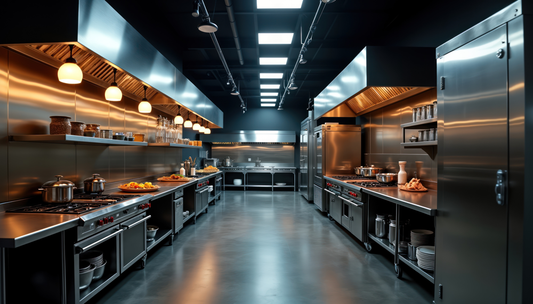
It's 7:42pm on a Friday. The line is two deep, the pass is calling for table nine, and I (Andrew Pickersgill, MD at eCatering) open the undercounter fridge on the garnish station - and I can feel the drift. Not cold. Not warm. Just… off. The kind of slightly-too-cool that tells you the compressor has been fighting the kitchen ambient for the last forty minutes, the door has been opened eighty times since service started, and by 9pm you'll be throwing out prep.
That moment - the one every head chef knows - is why this guide exists.
Choosing a commercial fridge isn't about picking a box that gets cold. It's about picking a box that stays cold through a 10-hour cover, in a 32°C kitchen, with fifty door openings an hour, and does it for eight years without calling out an engineer. Over thirty years in this trade I've watched operators buy the wrong fridge more often than any other piece of kit, and the reason is almost always the same: they bought a domestic unit, or they bought the cheapest commercial one without checking climate class. Both mistakes cost four-figure sums by year two.
This is the working buyer's guide we wish every caterer read before picking up the phone. Sits alongside our refrigeration pillar and our piece on modern upright fridge technology - read all three and you'll spec better than 90% of the market.
What a commercial fridge actually is - and why domestic won't cut it
Here's the clearest way to put it: a domestic fridge is designed for a household opening the door maybe 20 times a day, holding a loose 1–10°C range, in a lounge-adjacent kitchen that rarely tops 22°C. A commercial fridge is designed for 10–12 hours of continuous door cycles, a tight 1–5°C internal range, and an ambient that might hit 35°C at peak service.
The difference lives in three places.
Compressor duty cycle. A commercial unit is built to run 60–80% of the time. A domestic one panics past 40% and burns out.
Recovery time. After you open the door, a commercial fridge pulls back to target temp in 90–180 seconds. A domestic one? Three to five minutes, and it never fully catches up once service rhythm kicks in.
Gasket and hinge spec. Commercial door seals are rated for tens of thousands of cycles. Domestic seals go spongy inside 18 months of restaurant abuse.
This is also - and environmental health officers will back me on this - why using a Currys fridge behind the line can cause a non-compliance at inspection. You need documented temperature holding. Domestic kit doesn't give you that.
Key factors to consider before you buy
Six things to nail down before you even browse. Skip any of these and you will buy the wrong unit.
Capacity & GN Compatibility
Measure in Gastronorm. A 1/1 GN pan is 530 × 325mm - that's your unit of storage. Most undercounter fridges hold 2–3 GN 1/1 pans per shelf; a 600L upright holds 14–18. Count your prep load, double it for safety, then pick.
Space & Installation
Tape it out on the floor. Width, depth, and the 50–75mm ventilation gap on the rear and sides. Fridges are measured in external dimensions - check door swing against your walkway. Prep counters need finished-floor clearance for castors.
Power Supply
Almost every commercial fridge on our site runs on single-phase 13A - a standard 3-pin plug. Walk-ins and some blast chillers jump to three-phase. Check your socket count before you order; a packed kitchen line often runs short.
Temperature Stability & Recovery
This is the one nobody tests. Look for units with forced-air circulation (not static cooling), a recovery time of 180 seconds or under, and a digital thermostat with ±0.5°C accuracy. Cheap fridges use mechanical dials that drift 2–3°C over a year.
Running Costs & Energy Class
A 600L upright on natural refrigerant (R290 or R600a) costs roughly £125–£210 a year to run at 30p/kWh. A 1,200L double-door lands around £250–£300. Older R134a units can pull 20–40% more. Over an eight-year life that's real money - upwards of £800 on a single unit.
Warranty & Aftercare
Two-year parts-and-labour is the current UK baseline for mid-range. Premium tiers stretch to three. Ask about engineer response time - not the warranty length. A broken fridge mid-service with a 10-day callout is a disaster.
Types of commercial fridge explained
Six formats cover 95% of kitchens. Knowing which one you actually need saves thousands.
Undercounter
The workhorse. Sits at 850–900mm high under a prep bench, holds 100–150L, doubles as worktop real estate. Most stations on a line run one. Budget pick right now is the Gastroline 130L at £384.98 inc VAT - we stock this because the Quattro undercounter SKU is currently on pause. Mid-range is the Contender 130L at £441.36 inc VAT, and premium jumps to the Prodis at £579.98 inc VAT. See the full range at our undercounter collection, or read our undercounter vs upright comparison if you're torn.
Upright
The bulk-storage unit. 400L single-door all the way to 1,400L double. If you're buying once for a kitchen, buy upright - you'll never regret the capacity. The Contender 400L runs £528.49, the Contender 600L sits between £586.82 and £794.18 depending on finish, and the Contender 1,200L double-door is £1,305.98 inc VAT. Premium-end, the Ecofrost 650L at £1,313.46 or the Ice-A-Cool 1300L at £1,463.99 are what we spec into hotels.
Browse our full range of commercial fridges including all upright, undercounter and prep counter models.
Prep Counter / Saladette
A horizontal fridge with GN pan wells sunk into the top - built for pizza, salad, and sandwich assembly. Keeps toppings at 4°C while you work. The Contender prep counter range spans £523.57 to £1,422 ex VAT. If you're running a pizza shop or deli, this pays for itself inside six months in reduced waste.
Bottle Cooler
Back-bar spec. Glass door, interior LED, designed to display and hold drinks at 3–5°C. Contender bottle coolers from 220L to 320L run £353 to £461 ex VAT. Do not use these for food prep - the cycling profile is wrong.
Display Fridge
Front-of-house kit. Grab-and-go pastry, sandwiches, drinks. The Gastroline 100L counter-top display is £366.65, and Contender's glass-door double displays sit between £912 and £1,063 ex VAT. Temperature range is looser here (-1 to 7°C) to preserve visual appeal - which is why they're wrong for raw protein storage.
Walk-In
For serious volume - 1,500L-plus. Bespoke build, three-phase power, concrete pad install. Outside the scope of this guide, but if you're asking the question we'll come and quote it.
Blast Chiller (mentioned separately)
Not a fridge. A blast chiller pulls food from 70°C down to 3°C in under 90 minutes, running temps of 0°C down to -18°C. HACCP-critical kit for anyone doing cook-chill. Different category, different budget - worth knowing it exists when you're planning cold storage holistically.
Budget, Mid-Range and Premium - what you get at each tier
Three tiers, three different conversations.
Budget (Gastroline / entry-level): You get reliable Class 3 or Class 4 cooling, forced-air circulation, 12-month warranty, single-phase. Good for cafés, small delis, low-intensity service. The Gastroline 130L undercounter at £384.98 is our go-to here. What you give up: quieter compressors, thicker insulation, and longer warranty cover.
Mid-range (Contender): This is where most UK commercial kitchens should live. Contender dominates the category for us - undercounter, upright, prep counter, bottle cooler, the lot. Class 4 as standard, R290 refrigerant, 24-month warranty, ±0.5°C digital control. The Contender 600L upright is probably the most-sold unit we ship. Good for 80% of pubs, restaurants, hotels.
Premium (Ecofrost / Ice-A-Cool / Prodis): Class 5 where needed, three-year warranty, heavier gauge steel, quieter decibel rating, sometimes self-closing hinges. Keep the condenser clean - a dirty condenser is the number one cause of premium-unit failure we see. Ecofrost, Ice-A-Cool and Prodis sit here; so do the heavier Contender double-doors. For Michelin-adjacent kitchens, hotels with breakfast volume, or 24-hour operations.
Worth saying: finance is available across all three tiers, which makes the jump from budget to mid-range much easier to justify over three years.
Common mistakes caterers make when buying a fridge
Seven of them. In rough order of frequency.
-
Overloading. Stuff the shelves solid and you block evaporator airflow. Warm spots develop at the back corners, the compressor runs constantly, and within a fortnight your bottom shelf is reading 8°C. Leave 30–50mm around internal walls. Always.
-
Ambient too hot, ventilation gap skipped. You push a Class 3 fridge against a wall in a 34°C kitchen with no rear clearance. It will fail. Not "might" - will. Check climate class against your worst-case kitchen temp, and leave the manufacturer's specified rear gap (usually 50–75mm).
-
Not leaving rear clearance even when the climate class is right. Same issue, slightly different cause. Kitchen designers squeeze fridges into alcoves to save 40mm of floor space, and the condenser has nowhere to dump heat. Symptom: noisy compressor, short cycling, premature failure.
-
Buying the wrong type entirely. Using a bottle cooler for food prep (wrong temp profile). Using a display fridge for raw meat storage (illegal, technically). Using an undercounter when the kitchen actually needed a 600L upright (permanent capacity squeeze). Match type to job - re-read the section above if in doubt.
-
Skipping the pull-down test pre-service. A commercial fridge needs 4–6 hours to reach holding temp from ambient. Turn it on the morning of service, load warm stock at 3pm, and you've contaminated the entire cabinet's recovery curve. Pull-down the night before. Every time.
-
No defrost cycle management. Automatic defrost runs on a timer - usually every 6–8 hours. If you're in and out of the fridge constantly, humidity builds faster than the defrost clears it, and ice forms on the evaporator coil. Manual hot-gas defrost once a week prevents it. Nobody does it. Everybody should.
-
Door seals degrading. When gaskets go spongy, cold air leaks, warm air cycles in, and running costs jump by up to 30%. Test: slip a £5 note in the door seal and close it. If it pulls out without friction, the gasket needs replacing. £40 part, saves £200 a year.
When to speak to a Key Account Manager
If you're fitting out a new site, replacing three or more units, or your kitchen ambient regularly tops 32°C, a phone call saves you weeks of trial-and-error.
Our Commercial Director Andy Whitehead runs the KAM desk. Here's what he said when I asked him the most common spec error he corrects:
"I've spec'd fridges for butchers in Sheffield, gastropubs in Manchester, hotels in Edinburgh and cafés in Bath this year. The one constant? Every kitchen underestimates ambient temperature. A Class 3 fridge in a 35°C kitchen is a breakdown waiting to happen. Measure your ambient at peak service, not at 10am. That one number changes the whole spec."
- Andy Whitehead, Commercial Director, eCatering
Meet the rest of the KAM team here. No consult fee, no pressure - we'd rather you bought the right unit once than the wrong one twice.
Frequently Asked Questions
What temperature should a commercial fridge be?
1–5°C for a standard chiller, with 3°C the sweet spot for food safety and energy efficiency. Display fridges run slightly looser at -1 to 7°C. Blast chillers operate from 0°C down to -18°C. Your Environmental Health Officer will expect daily logged readings - every morning, every evening, on a paper sheet or digital logger.
How much does a commercial fridge cost in the UK?
Budget undercounter from £385 inc VAT (Gastroline 130L). Mid-range 600L upright around £586–£794. Premium 1,300L double-door up to £1,463. Walk-ins start at £4,000 and scale on build size. Running costs add £125–£300 a year on top for a single upright unit.
Undercounter vs upright - which do I need?
Undercounter if floor space is tight, prep volume is modest, and you want worktop on top. Upright if you need bulk storage, multiple shelf zones, or you're running more than 50 covers a service. Most professional kitchens run both - one undercounter per station, one or two uprights for bulk. Full breakdown in our undercounter vs upright comparison.
Do I need Class 3, Class 4 or Class 5 climate rating?
Class 3 is rated to 25°C ambient (office kitchens, cold storage rooms). Class 4 is rated to 30°C (most UK commercial kitchens). Class 5 is rated to 40°C (pizza ovens nearby, summer peaks, busy back-of-house). Our advice: Class 4 minimum. If your kitchen pushes past 32°C in July, spec Class 5.
Why is my commercial fridge struggling in summer?
Three likely causes. First, climate class is under-spec for your ambient - Class 3 unit in a 33°C room will fail every summer. Second, condenser coil is clogged with kitchen grease and dust - vacuum monthly. Third, door seals are tired and warm air is cycling in. Fix all three before calling an engineer.
Can I use a domestic fridge in a commercial kitchen?
Technically not illegal, but practically a disaster and a compliance risk. Domestic units aren't built for the duty cycle, the recovery time is too slow to hold 5°C through service, and EHOs will flag it during inspection. Buy commercial. It's cheaper over three years.
Final word
The right commercial fridge is the difference between a calm service and a binned prep tray. Get the type right, get the climate class right, leave the ventilation gap, and you'll forget the fridge even exists - which is exactly what you want. Browse our full range of commercial fridges - upright, undercounter and prep counter models with next-day UK delivery.
If you're sizing a new site or replacing old kit, browse the Contender range for mid-market spec, the Quattro line for budget, or talk to a KAM about premium. And if you're planning a full kitchen build, our commercial kitchen equipment list is the place to start.
We've got your back.
- Andrew Pickersgill, Managing Director, eCatering
────────────────────────────────────────
Prices shown as of April 2026 (mix of inc/ex VAT as noted) and subject to change. Always check product specifications, climate class ratings and ventilation clearance before ordering.