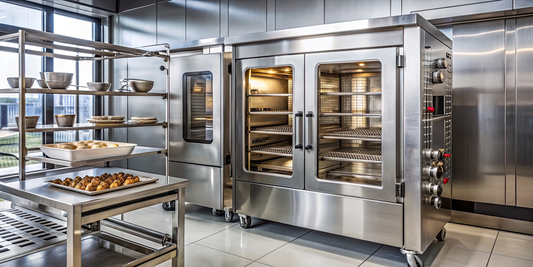
This is the single most common oven question we hear from operators fitting out a commercial kitchen: should I buy a combi oven or a convection oven? The price gap is significant, the capabilities overlap, and the wrong choice either leaves you overpaying for features you don't use or scrambling to cook things your oven can't handle.
The short answer: a convection oven bakes and roasts with circulated hot air. A combi oven does everything a convection oven does, plus adds steam - which unlocks an entirely different set of cooking techniques. Whether that extra capability is worth the extra cost depends on your menu, your volume, and how much versatility you actually need.
What Does Each Oven Actually Do?
Convection Ovens
A convection oven uses fans to circulate hot air evenly around the cooking cavity. This eliminates the hot spots you get in a static oven, gives you consistent results across every shelf, and speeds up cooking compared to traditional radiant heat.
Convection ovens are excellent for:
-
Baking (bread, pastries, cakes, pies)
-
Roasting meats and vegetables
-
Gratins and baked pasta dishes
-
Reheating and holding at temperature
-
Any task where dry, even heat and browning are the goal
They're simple, reliable, and well understood. A good convection oven does a handful of things very well. The limitation is that dry heat is all you've got - no steam, no humidity control, no combination cooking.
Combi Ovens
A combi oven - short for combination oven - gives you three cooking modes in a single machine:
Convection mode works identically to a standalone convection oven. Hot air, circulated by fans, for baking and roasting with dry heat.
Steam mode introduces steam into the cavity, cooking food gently at lower temperatures (typically 30–130°C). This is how you steam vegetables, fish, and rice without a separate steamer. Because steam transfers heat more efficiently than dry air, food cooks faster and retains more moisture, colour, and nutrients.
Combination mode blends dry heat and steam simultaneously. This is where a combi oven genuinely separates itself. You can roast a chicken with convection heat for crispy skin while injecting steam to keep the meat juicy inside. You can bake bread with steam injection in the first few minutes (for crust development) and then switch to dry heat to finish. You can hold delicate proteins at precise humidity levels that prevent drying out.
The combination mode also reduces shrinkage. Meat cooked in a combi oven loses less moisture during cooking - industry figures suggest up to 20% less weight loss compared to convection-only cooking. Over hundreds of portions per week, that adds up in yield and food cost.
Head to Head: The Practical Differences
What You Can Cook
A convection oven covers baking and roasting confidently. If your menu is built around those two techniques - a bakery, a pizza operation, a pub kitchen doing roast dinners and pies - a convection oven handles the workload.
A combi oven covers baking, roasting, steaming, poaching, braising, blanching, regenerating, and holding. If your menu spans multiple cooking techniques, a combi oven replaces several pieces of equipment: the convection oven, the steamer, potentially the bain-marie for holding. One machine, one footprint.
Capacity and Sizing
Both oven types use the gastronorm (GN) system for tray sizing. The standard is GN 1/1 (530 × 325mm), and ovens are rated by how many GN trays they hold:
-
6-tray - Compact. Suits small cafes, sandwich bars, pubs with limited menus. Fits a standard 600mm-wide counter run.
-
10-tray - The workhorse for most restaurant kitchens. Handles a full menu across multiple trays with enough capacity for a busy lunch and dinner service.
-
20-tray - Large scale. Hotels, banqueting, hospitals, school kitchens, or any operation cooking high volumes simultaneously.
The tray count is the same concept for both convection and combi ovens. A 10-tray combi and a 10-tray convection oven hold the same number of gastronorm trays - the difference is what you can do with the food once it's inside.
Energy and Running Costs
Combi ovens are generally more energy-efficient per unit of food cooked, for two reasons. First, steam transfers heat more efficiently than dry air, so food reaches temperature faster. Second, combination mode often allows lower oven temperatures for the same result, reducing energy draw over long cooking cycles.
Industry data suggests combi ovens can reduce energy consumption by up to 30% compared to convection ovens for equivalent cooking tasks. However, combi ovens draw more power at peak - a 10-tray electric combi typically needs a three-phase supply and pulls 15–20kW, compared to 5–10kW for a convection oven of the same size.
The net running cost depends on how you use the oven. A combi running in convection-only mode all day won't save you anything over a convection oven. The efficiency gains come from using the steam and combination modes for tasks that would otherwise take longer or require separate equipment.
Upfront Cost
This is where the gap is starkest. A commercial convection oven starts from around £500–£1,500 for a quality 4–6 tray unit. Larger 10-tray models sit between £1,500–£3,000.
Combi ovens start higher. A compact 6-tray combi runs £2,000–£5,000. A 10-tray unit from a mid-range manufacturer costs £4,000–£8,000. Premium brands like Rational or Convotherm sit at £6,000–£13,000+ for 10–20 tray models.
That's a significant difference. But if a combi oven replaces both a convection oven (£1,500) and a standalone steamer (£1,000–£2,000), the gap narrows. Factor in the smaller kitchen footprint (one machine instead of two), lower food waste from reduced shrinkage, and faster cooking times, and the total cost of ownership over five years can favour the combi - especially in high-volume kitchens.
If you're weighing up options, our commercial combi ovens includes compact and full-size models, and our convection oven range covers 3-tray to 10-tray units - all with free delivery and flexible payment options.
Installation Requirements
Convection ovens are straightforward to install. Electric models need a suitable power supply (13A plug for smaller units, hardwired for larger). Gas models need a capped gas point and a CP42 gas safety certificate from a Gas Safe registered engineer after connection.
Combi ovens are more demanding. Beyond the power or gas connection, they need:
-
Water supply - Combi ovens need a mains water connection for steam generation. Some compact models have a manual fill tank, but most commercial units require a plumbed supply.
-
Water drain - Steam creates condensation that needs to drain away. A floor drain or connection to the waste pipe is typically needed.
-
Water treatment - Hard water causes limescale build-up in the steam generator, which is the most common cause of combi oven breakdowns. A water softener or filter is strongly recommended - and many manufacturers require one to maintain the warranty.
-
Extraction - Combi ovens produce steam when the door opens. Your extraction system needs to handle this, and many installations benefit from a condensation hood directly above the oven.
These additional requirements add to the installation cost. Budget £500–£1,500 for water connection, drainage, and filtration on top of the oven price.
Maintenance and Descaling
Convection ovens need standard cleaning - wipe down, occasional degreaser cycle, check door seals. Straightforward.
Combi ovens need everything a convection oven does, plus regular descaling of the steam generator. Limescale from hard water is the number one enemy of combi ovens. Most modern combis have an automatic cleaning and descaling cycle that runs overnight using manufacturer-supplied tablets or liquid. Skipping this cycle shortens the life of the boiler significantly.
A well-maintained combi oven lasts 8–12 years in a busy commercial kitchen. A neglected one - particularly one running without a water filter in a hard water area - can develop boiler problems within two to three years. Factor in the cost of descaling chemicals (typically £30–£60 per month) and water filtration cartridges (£50–£150 per replacement, every 6–12 months).
So Which Should You Buy?
Buy a convection oven if:
-
Your menu is focused on baking and roasting
-
You don't need steam cooking capabilities
-
Budget is a primary constraint and you need to keep upfront costs low
-
Your kitchen doesn't have (or can't easily add) a water supply near the oven position
-
You're running a bakery, pizzeria, or simple pub kitchen where dry heat handles 90%+ of your cooking
Buy a combi oven if:
-
Your menu spans multiple cooking techniques (roasting, steaming, braising, baking)
-
You want to replace a convection oven and steamer with one machine
-
Food quality and consistency are differentiators for your business
-
You're cooking proteins in volume and want to reduce shrinkage and improve yield
-
You have (or can install) water supply, drainage, and filtration at the oven position
-
You're willing to invest more upfront for lower food costs and greater versatility long-term
For a broader comparison of all commercial oven types - including deck ovens, conveyor ovens, and cook-and-hold - our guide to choosing a commercial oven covers the full range. And our commercial kitchen equipment list shows how ovens fit into the wider kitchen layout alongside prep, refrigeration, and service equipment.
Frequently Asked Questions
Can a combi oven fully replace a convection oven?
Yes. Every combi oven has a convection-only mode that works identically to a standalone convection oven. If you buy a combi, you don't also need a separate convection oven - the combi does both jobs. The only scenario where you might keep a separate convection oven alongside a combi is if you need the additional tray capacity during peak service.
Do I need three-phase power for a combi oven?
Most 10-tray and larger electric combi ovens require a three-phase electrical supply due to their high power draw (15–20kW+). Compact 6-tray models may run on a single-phase supply, but check the specification before purchasing. If you don't currently have three-phase power, installation costs typically range from £3,000–£5,000+ depending on your building and the distance from the supply point.
How much water does a combi oven use?
Water consumption varies by usage, but a busy combi oven running steam and combination modes throughout service uses roughly 20–50 litres per day. The bigger concern isn't volume - it's water quality. A water softener or filter system is essential in hard water areas to prevent limescale damage to the steam generator.
Is a combi oven worth it for a small cafe?
It depends on your menu. If you're doing sandwiches, baked goods, and simple reheating, a convection oven is more cost-effective. But if you're offering a varied menu with steamed items, proteins, and baked goods - or if you want to batch cook and regenerate efficiently - a compact 6-tray combi can be transformative for a small kitchen. The space savings alone (one machine instead of two) often justify the investment.
Prices and specifications mentioned are approximate UK market ranges. Always check the specific power, water, and extraction requirements for any oven model before purchasing. Gas installations require a CP42 certificate from a Gas Safe registered engineer.